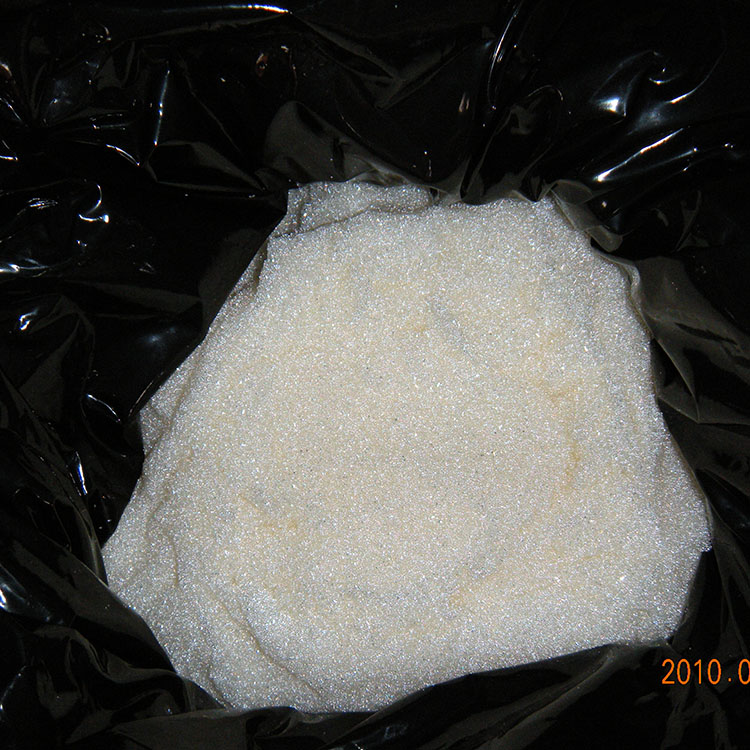
This product is a weakly basic anion exchange resin containing primary amine (-NH₂), secondary amine (=NH), tertiary amine (≡N) and quaternary ammonium (=N=) groups, produced by polycondensation of epichlorohydrin and polyethylene polyamine at high temperature. It exhibits ion exchange functionality in acidic, neutral and even alkaline media. Featuring high total exchange capacity and fast exchange rate, it is mainly used for decolorization of stevia glycosides.
I. Physicochemical Performance Indicators
| Indicator Name | Specification |
|---|---|
| Appearance | Golden spherical beads |
| Shipping Form | Free amine form |
| Moisture Content (%) | 60–70 |
Notes
This resin is resistant to organic fouling. Macromolecular organic substances adsorbed on the resin can be easily eluted, resulting in a long service life.
- This product contains a certain amount of moisture and shall not be air-dried; it must be stored in a moist state. If drying is found, replenish moisture immediately. Store above 0℃ in winter to avoid freezing damage to resin strength. Avoid direct sunlight and excessively high temperatures in summer to prevent mold growth.
The maximum operating temperature of this product is 100℃.
- This product is an industrial-grade product, not a chemically pure reagent. If used in the food and pharmaceutical industries, purification treatment must be carried out in advance:
- First, wash thoroughly with ordinary tap water until the effluent is clear.
- Then perform 2–3 alternate treatments with 4% HCl and 4% NaOH. The dosage of acid/alkali is approximately twice the resin volume, with dynamic downstream flow.
- Thoroughly wash with water between acid and alkali replacement to complete resin conversion (acid treatment converts to chloride form; alkali treatment converts to hydroxide form).
- Utilize the shrinkage and expansion during conversion to wash out impurities with plenty of water.
- Finally, soak 1–2 times with 95% ethanol to dissolve impurities soluble in organic solvents.
- Convert to the required form in accordance with formal process requirements before use.
- Resin Regeneration:
- Soak exhausted resin with 4% HCl for 2–3 hours (dosage: twice the resin volume), then wash with water to neutrality.
- Then soak with 4% NaOH for 2–3 hours, then wash with water to neutrality.
- If a large amount of pigment is adsorbed and the resin is deeply colored, soak with 95% ethanol for 3–4 hours, wash with water, and recycle for reuse.